
Employee Termination process improvement
Challenge:
The process was identified as critical because its execution resulted in the termination of the employee-company relationship and contained a series of requirements stipulated by law to be fulfilled, as well as checks and documentation necessary to support the process and avoid the possibility of risk of labor lawsuits.
IIPMS Implementation:
Applying the 1st phase of IIPMS, process improvement, a complete mapping was made of the activities carried out by the different HR analysts and other employees involved in the process in each of the Plants. Several opportunities and flaws were detected in the process. Each of the 6 plants had its own processes and standards for recording termination. There was a loss of information because each analyst kept their processes on their laptops and emails (a high risk of non-compliance with legislation). In the absence or departure of this professional, all information was lost as access was non-transferable. Another critical factor was non-payment within the deadline stipulated by law (10 calendar days) as the process was slow and there was no established checking flow. This delay in paying severance pay to the employee generated a fine provided by law, of an additional salary, not budgeted. Here, at this stage, it was verified that the process presented tangible and intangible losses. Some locations did complete checklist and others only did the basics, with no task standardization.
Customer:
Consumer goods industry – HR dept
Project Lenght:
3 months
There was also no process KPI control panel. There was no visibility at a national level of how many and at what stage the employee dismissal processes were taking place. What little control there was local and personal (depending on the local manager).
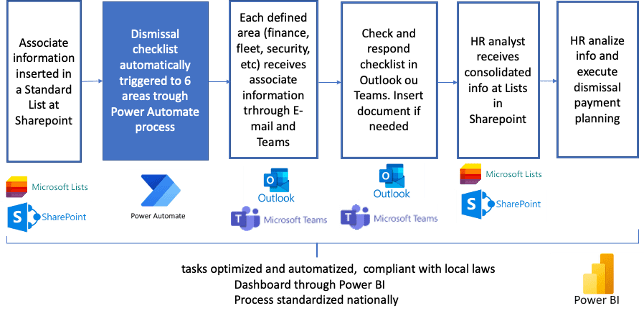
The completion of phase 1 of IIPMS resulted in a series of improvements proposed by the team, which participated in the entire application of the methodology, bringing standardization and adaptation of activities in accordance with the requirements set out in law. Part of the actions were immediately implemented. Actions that were identified as potential activities to be automated moved to the 2nd phase of IIPMS – automatization (picture above).
It was developed a single, centralized checklist for collecting the information necessary to support the employee termination process. This solution was implemented to standardize, automate and document the entire termination process, so that it is more procedural, centralized and less dependent on one or more specific HR users.
It was built the automatic shutdown checklist using the Microsoft Lists and Power Automate tool. The HR employee triggers the termination record in Sharepoint and the process automatically sends emails to each of the responsible areas (6 in total) so that they can return the information (via Outlook and MS Teams), in time, to so that HR can process the payment and have the records and documents centralized on a single basis (sharepoint), no longer on the professional’s corporate email.
These returns concerned everything that could affect the calculation of the employee’s termination. Example: if the employee had any outstanding balance, if he needed to return any work tools, if he had any traffic fines, if he used a corporate vehicle, etc.
This flow also allowed automatic SLA (site level agreement) warnings to be inserted to ensure deadlines were met. On average, 1200 registrations were performed with this implementation in its first year of use.
Results and Outcomes:
The process significantly reduced the HR employee’s time as they no longer needed to search for answers, those who carried out this process, from the checklist manually in their corporate email. As a result, we estimate a saving of 3 minutes per processing per analyst, a total saving of 60 hours per year, documents stored as required by law, in addition to eliminating the payment of fines for late employee termination.
Furthermore, as a result, with the execution of this second phase, It was built an executive Dashboard for visibility of the system’s health.
This initiative was approved by the Company’s leadership board and Legal Team, also recognized its importance in the journey of eliminating errors when terminating employees and executing severance payment.
 Fit for Achievement